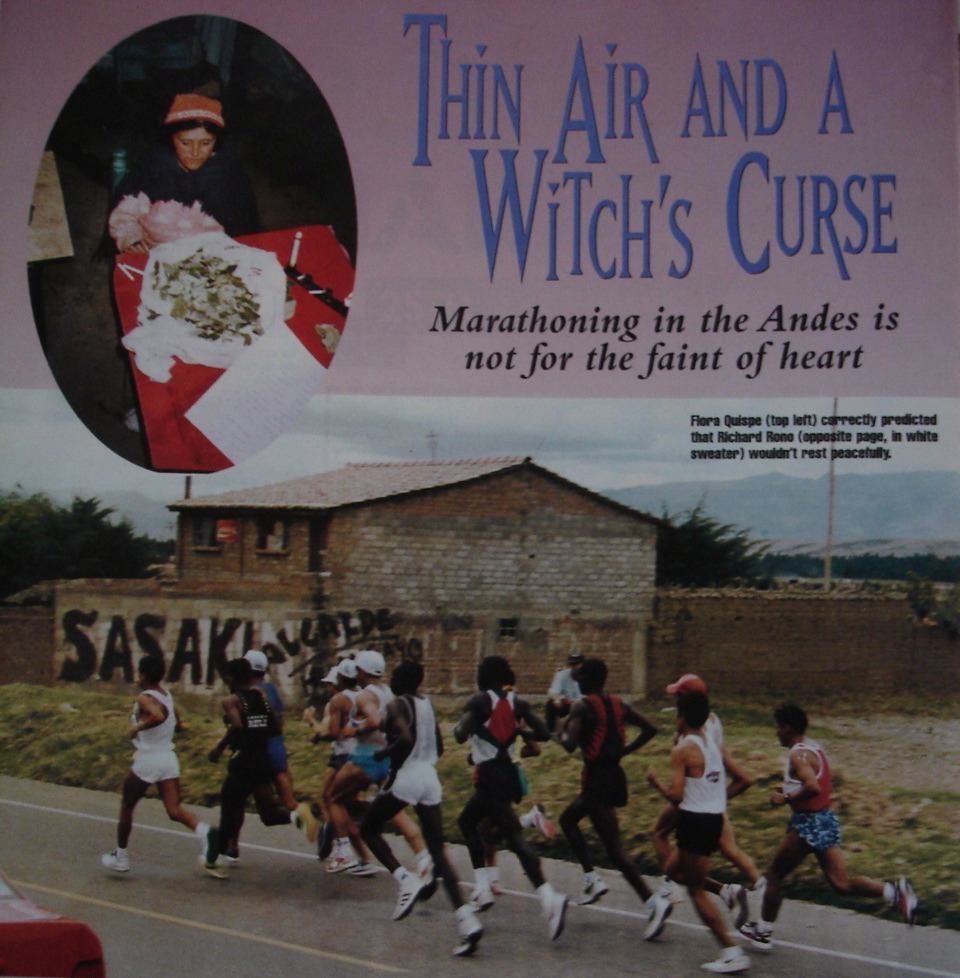
On the evening before the event last fall, my determination to cover
every angle of the race led me to a tiny, poorly lit adobe hut on
Flora’s farm property. The small, weathered woman, wearing
layers
of cotton and alpaca-wool clothing, seemed intrigued by my visit. I sat
across from her at an uneven wooden table as she lit two small candles.
I said I wanted to know about the next morning’s race, a
full-length marathon between the cities of Jauja and Huancayo, more
than two miles above sea level in the Andes. She closed her eyes, and
the room feel silent as she considered the question carefully.
“You say they run all the way from Jauja?” she
asked finally, eyes still closed. I said they did.
“On foot?”
I told her that was correct.
“Are you very sure?” She opened her eyes and looked
at me
accusingly; I eagerly nodded. She stood up and walked to the door.
Before leaving, she turned to me and said quietly, “Then this
is
serious.”
Flora returned with a small, cloth bag filled with coca leaves and some
hand-rolled cigarettes. I unfolded a list I had prepared of the 12
favorites in the men’s race, and she spread the leaves over
it.
There were names from as far away as Kenya, Belgium, and Mexico. One of
Flora’s hands hovered over the leaves as the other spread the
smoke from her lit cigarette over the table. I stifled a cough as she
studied the swirls of smoke and the leaves beneath them. Some time
passed, and she slowly cleared away the leaves from part of the list
and pointed to one name. “This one,” she said.
“This
one is not sleeping well tonight.”
None of the top runners seemed too
concerned about
the altitude. “It slows you down, but it’s just
another
factor, like hills or the weather,” chirped a diminutive
Belgian
Eddy Hellebuyck, who had finished 40 races, including eight marathons,
in the ten months prior to this effort. He said the course -- a mostly
flat, point-to-point route through the Montero Valley -- would have
sub-2:10 potential at sea level. As it was, despite the altitude, he
predicted that to win it could take a sub-2:20, well under the course
record of just under 2:26.
“They’ve never had this kind of field here
before,”
he explained. That was true enough. Race directors went far beyond any
previous efforts to bring in top international athletes. At least half
a dozen athletes had previously represented their countries in the
Olympics or will do so in Atlanta, and 14 foreign countries were
represented, compared with four the year before. At a public meeting
with the top runners two days before the race, local kids surrounded
the invitees well beyond the allotted time, seeking au

tographs, handshakes, or words of encouragement.
This town of about 200,000 is the running capital of Peru --
it’s
the only city in the country where the municipal stadium is set up with
an eight-lane, 400m tartan track as the centerpiece, instead of a
soccer field--and it’s easy to see why.
“These kids, the grow up looking at the runners as role
models,” said school teacher Florinda Camayo, a Huancayo
native
and one of the leading favorites in the women’s race.
“The
best athletes grow up wanting to be runners.”
It shows. The local track record is just under 30:00 for 10,000 meters
and just over 14:00 for 5,000 meters, despite being situated at
precisely 10,911 feet. (Only a dozen U.S. states have mountain peaks
that high; none have major track meets.) Some of the elite runners
training a few days before the race reported groups of young kids
following along, mimicking their running styles.
Little wonder, then, that Flora’s coca leaves the night
before
the start gravitated toward the names of some local runners. Before I
left the hut, she had made three predictions, though she shied away
from an outright selection of a winner. She singled out someone who
would do better than expected, someone who would do worse, and, of
course, someone who was sleeping fitfully in his bed as she and I spoke.
Confirmation of the last prophecy came first, amid the buzz at the
starting line.
Looking
for the unlucky runner Flora had picked, I noticed a young man on the
side of the road, with a typical multicolored mountain stocking cap,
poncho, and backpack, who hopped up and down and tried to look serious.
A few meters away, a heavy-set man in street shoes was assuring his
crying wife that he could run all the way to Huancayo without hurting
himself. Several porters, in their shin-length pants and tire tread
sandals, did lunging exercises fitting of a boxer’s pre-fight
routine. In this carnival atmosphere, the elite runners were easy to
pick out, with the matching shorts and singlets and their long, smooth
strides.
Some stuck out for other reasons. Four Kenyan runners attracted
immediate attention because their dark skin was so foreign in the
remote Andes; one in particular, Richard Rono, was a hit because of the
way he was captivated by the town’s goodwill. He received
several
small gifts from the locals, and only with great effort the evening
before the race was he able to break away from the crowds to rest.
“Tell them I love them all,” he said to one English
speaker
before heading back to his hotel. “Tell them that when I run
the
race, I will run it for them.” That’s why I felt
sad when
Flora told me it was Rono who was having sleeping problems. At the
start, I saw him jogging about, and I interrupted him for a moment to
ask how he felt. “OK, I guess, “ he said.
“Developed
a little cough, and I had a hard time sleeping, but I feel fine
now.” It was a moment before I was able to smile weakly and
tell
him he would be fine.
When he was out of sight, I immediately started looking for local
runner Silviano Simeon, who Flora had predicted would do unexpectedly
well. He seemed like a good choice, even though it was his first
marathon. He looked confident during pre-race strides, and he had run
1:04 for a hilly half marathon at sea level a month before. Then I
sought out Mexican Moises Requena, who was fourth the year before,
despite arriving at altitude less than 24 hours before the start. He,
too, looked strong, and with ten days in Huancayo for preparation this
time, he seemed like a good bet to finish near the top. Yet Flora had
predicted he wouldn’t run up to expectations.
All three were among the leaders at the halfway point, as the pack
dwindled to about a dozen. Requena was the first of the three to lose
contact, after dropping back several times and struggling to rejoin the
pack. It was a futile effort, and he finished a disappointing 16th in
2:46:56, almost 20 minutes slower than the year before when he had just
a fraction of the preparation. He told me later that he just had an
inexplicably bad day. But his performance made Flora two for two.
Her perfect record was spoiled around the 30-kilometer point when
Simeon lost contact and later dropped out. Rono also dropped out just
past the 30-kilometer mark, as the pace quickened and he developed
breathing problems related to the cough that had kept him awake the
night before.
Almost all of the favorites did much worse than expected, so
Flora’s prediction about Requena was less impressive in
retrospect. Five of the 12 runners on my list dropped out, and many of
the finishers ran their slowest races ever. Mexican Ignacio Sanchez was
fifth in 2:32:57, his slowest marathon by 10 minutes. Columbian Oscar
Rodriguez ran his slowest by 11 minutes when he finished 11th in
2:40:22, and 1988 Olympic 10,000 meters bronze medalist Kip Kimeli of
Kenya, ran 2:42:53 for 14th, his slowest marathon by more than 17
minutes.
Emerging from all the dashed plans was unheralded Policarpio Calizaya
from La Paz, Bolivia, a two-time runner-up in Huancayo, who ran
2:25:26, a course record by just 9 seconds. Edgar Rodriguez and
Gilberto Torres, both from high in the Andes, took second and third,
ahead of Hellebuyck, who broke the pack up with a surge at 35
kilometers and held on to finish fourth in 2:31:46.
Hellebuyck was an anomaly -- the only finisher in the top 23 who
didn’t grow up at a high altitude. In his first-ever race in
Peru, the three runners who beat him had run the race 14 times
combined, with a total of six top-three finishes, and Rodriguez and
Torres had each won it once previously.
The women’s race was equally dominated by high-altitude
runners,
who took the top 25 slots. Camayo won her fourth title in what was most
likely the most impressive performance of the day, smashing her course
record by more than 7 minutes in 2:53:20, more than 10 minutes ahead of
local rival Marilu Salazar. Bolivian Justina Calizaya,
Policarpio’s sister, was third, and Mary Carmen Perez was the
top
first-time women’s runner in fourth, traveling from her
high-altitude home in Mexico City.
The evidence clearly favored altitude-trained runners, but that
didn’t stop many sea-level athletes from promising to return
and
improve on their performances the following year. Even Flora Quispe,
the
bruja
who had confidently
hit the target on two of her three predictions, in her own way,
cautioned against pretending to understand the marathon, especially in
Huancayo.
“I must tell you this,” she said in a solemn tone
as I left
her adobe hut the night before the race, “I must admit I
could be
wrong about everything.”
Eric
J. Lyman is a freelance writer based in Peru and a former
university-level distance runner. He completed the Marathon of the
Andes in 3:14:41, good for 40th place overall.
RESULTS
Men
1. Policarpio Calizaya (BOL) 2:25:26
2. Edgar Rodriguez (PER) 2:28:07
3. Gilberto Torres (PER) 2:28:43
4. Eddie Hellebuyck (BEL) 2:31:46
5. Ignacio Sanchez (MEX) 2:32:57
Women
1. Florinda Camayo (PER) 2:53:20
2. Marilu Salazar (PER) 3:03:37
3. Justina Calizaya (BOL) 3:13:12
4. Mary Carmen Perez (MEX) 3:14:27
5. Norma Saavedra (MEX) 3:15:59
Copyright © 1996 Running Times
All rights reserved