| But it is easy to imagine that most media outlets would buckle under such pressure.
It is also relatively easy for powerful figures with a range of financial interests like Berlusconi to have problematic journalists There is no love lost between Berlusconi
and Travaglio, who in 2001 co-authored a book called L’Odore dei Soldi (The Smell of Money), which alleged a strong connection |
doubted the direct or indirect influence of Berlusconi played a role.
“I think Berlusconi gave a precise order because he wanted to silence one of his most vocal critics and to send a message to other critics out there,” Travaglio says.
Michele Santoro, the program’s host (and himself a victim of Berlusconi’s wrath from 2002 when the prime minister
had him temporarily moved to an off-screen job at RAI), insisted Travaglio be reinstated. |
Emboldened, Travaglio has since started Il Fatto (The Fact), a daily newspaper that he says is Italy’s first completely free of special interest influence. Economically supported by ad sales and subscriptions alone, it was profitable out of the gate. It has already earned a few scoops, and its commentaries are raising eyebrows across Italy and beyond. “There are very worrying signs about the issue of press freedom in Italy, but there are positive signs as well,” he says. “Maybe the current Berlusconi era will be seen as a war that the Italian media goes through in order to emerge healthier on the other side.”
Others are less sure. “Each lawsuit, each time someone in the media loses their job for the news they state, that lowers the quality of programming and it acts as a disincentive for the best people to go into media,” says Affinito. “Eventually, that has a big effect on the public discourse, when there’s no doubt that a healthy public discourse
Berlusconi’s spokesman did not reply to requests to be interviewed for this article. |
This article originally appeared in Global Journalist
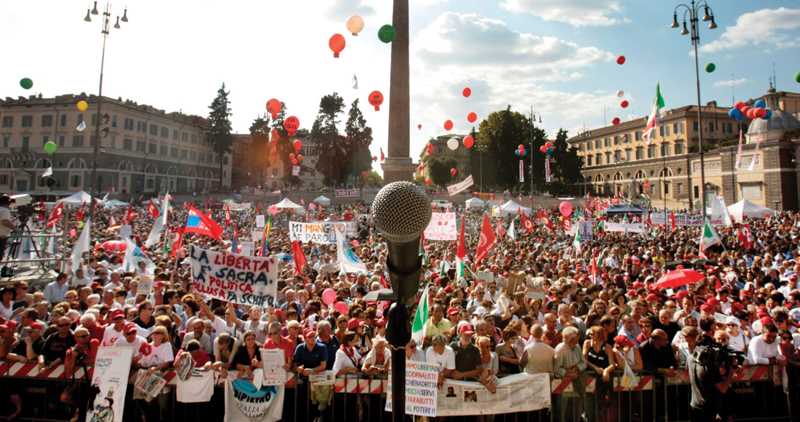 On Oct. 3, thousands of protestors gathered in Rome’s Piazza del Popolo (People’s Square) to defend press freedom.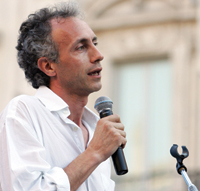
Winter 2009-2010 GLOBAL JOURNALIST